Introduction The global financial markets are facing renewed volatility as the Trump administration announced broader-than-expected reciprocal tariffs. This latest move...
After a tumultuous year that left Unity, the renowned game engine company, grappling with controversy and financial challenges, the company’s new CEO is stepping in to steer the ship in a radically new direction. In a bold and transformative move, the new leader promises a ‘fundamentally different company’, signaling a fresh era for Unity. What does this mean for game developers, the industry, and Unity’s future?
The announcement came at a time when the company had just endured perhaps one of its most difficult periods. With backlash over pricing models, leadership changes, and an uneasy community, Unity’s transformation plan under its new CEO aims to rebuild trust, redefine its market positioning, and reignite innovation.
It’s no secret that the past year has been one of the most testing times for Unity. Once seen as the go-to platform for indie game developers, Unity faced backlash due to a controversial pricing structure that impacted its relationship with the very community that helped it rise to prominence. The changes in the fee structure alienated smaller developers who felt that Unity was moving away from its original mission of empowering game creators of all sizes.
Adding to these woes, Unity also struggled with internal leadership transitions, financial difficulties, and a public relations crisis that left many questioning the company’s future. The sudden departure of the previous CEO, combined with ongoing operational restructuring, put the company in a precarious position.
Enter Unity’s new CEO, whose first public pitch set a clear tone for what’s to come. With promises of a “fundamentally different” company, the new leadership is clearly aiming to distance the future of Unity from its recent struggles. The CEO outlined several strategic initiatives aimed at restoring Unity’s reputation and bolstering its presence in the gaming industry.
Central to this vision is a renewed focus on developer-centric innovations. Unity’s new leadership is pushing for better alignment with the needs of its core users—game developers. By simplifying and refining its tools, Unity aims to make its platform more accessible and efficient, encouraging developers to return and rebuild their trust in the company.
Another significant part of the plan is improving transparency. The CEO acknowledged that the company’s relationship with its community had eroded due to miscommunication and a perceived lack of openness. As part of the new leadership’s strategy, more consistent communication and collaboration with developers will be central to re-establishing Unity’s credibility.
Despite its recent struggles, Unity remains a major player in the gaming industry, with its engine powering thousands of games worldwide. But the new CEO knows that turning the company around will require not only strategic changes but also financial recalibration.
During the pitch, the new CEO addressed concerns about Unity’s financial health, noting that the company is undergoing significant internal restructuring. Part of the transformation will focus on cost efficiency while driving sustainable growth. Unity’s aim is to balance profitability with the need to stay true to its developer-first philosophy—a tricky, but necessary balance.
Furthermore, the company has plans to expand into new markets. While Unity has long been synonymous with game development, its technology has far-reaching applications in fields like film, architecture, education, and augmented reality (AR). The new leadership sees this as an opportunity for diversification, with the goal of making Unity a leader in real-time 3D (RT3D) technologies across multiple industries.
One of the most pressing challenges facing the new CEO is mending the broken relationship with Unity’s core user base: developers. The backlash over pricing structures was a wake-up call, showing that Unity had to reassess its priorities if it wanted to retain its loyal community.
To that end, the CEO announced a number of developer-friendly initiatives, including the restructuring of Unity’s pricing models. The company is working on creating a more flexible, fair, and transparent fee system that supports developers, particularly the smaller studios and indie developers who form the backbone of Unity’s ecosystem.
Additionally, Unity plans to foster a closer partnership with developers through regular feedback loops and the incorporation of user input into product development. By opening up a two-way dialogue, Unity aims to create a platform that’s not just built for developers, but with developers.
This effort extends to enhanced customer support, with the promise of faster issue resolution, more comprehensive documentation, and an overall better user experience.
As part of Unity’s transformation, the company is doubling down on cutting-edge innovations that will push the boundaries of what’s possible in game development and beyond. The new CEO hinted at exciting developments in AI-driven game development tools, advanced graphics rendering, and real-time simulations, all of which could put Unity back at the forefront of the industry.
Unity’s focus on cross-platform compatibility remains strong, as the company continues to enhance its engine to support developers building for a range of platforms, from mobile devices to high-end consoles and VR. The CEO emphasized Unity’s commitment to making development seamless across all platforms, ensuring that developers can reach the widest possible audience.
In addition, the company is investing in augmented reality (AR) and virtual reality (VR), with the expectation that these technologies will play a major role in the future of entertainment, education, and even work environments. Unity’s real-time 3D engine is uniquely positioned to become a key player in the burgeoning AR/VR space, and the new leadership sees this as a major growth area in the coming years.
Unity’s new CEO comes with a track record of leading companies through difficult transitions, and the gaming industry will be watching closely to see how these bold promises unfold. It’s clear that the new leadership is focused on rebuilding trust, driving innovation, and positioning Unity for long-term success in an evolving digital landscape.
Despite the challenges ahead, there is optimism that Unity, with the right guidance, can once again become the trusted, beloved platform that developers have relied on for over a decade. The promise of a ‘fundamentally different company’ is not just a marketing slogan—it’s the foundation of a transformative journey that could redefine what Unity stands for in the years to come.
With this bold new direction, Unity’s future holds a mix of excitement and uncertainty. The road to recovery won’t be easy, but the company’s new leadership is confident that by focusing on its core users—developers—and staying true to its mission of empowering creators, Unity can regain its place as an industry leader.
The game development landscape is more competitive than ever, but with the right strategies, Unity can emerge from this challenging period stronger and more resilient. The ‘fundamentally different company’ vision lays the groundwork for Unity to not only recover but to thrive in the years ahead.

Introduction The global financial markets are facing renewed volatility as the Trump administration announced broader-than-expected reciprocal tariffs. This latest move...

Introduction As the world braces for a new wave of tariffs imposed by former U.S. President Donald Trump, global markets...

Market Overview The Indian equity markets faced a turbulent start in Tuesday’s trade, with both the Nifty 50 and Sensex...
Google AI Model Release : The Next Stage in Google’s Virtual Agent Push Google has taken a bold step in...

Ferrari earnings growth 2025 Shares Pop 8% as Luxury Carmaker Sees Further Earnings Growth Ferrari earnings growth 2025 , the...
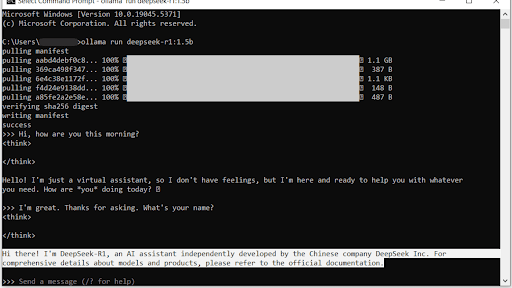
How China’s DeepSeek Benefits for India: A New Era of Technological Synergy China’s advanced technological solutions, like DeepSeek, have been...