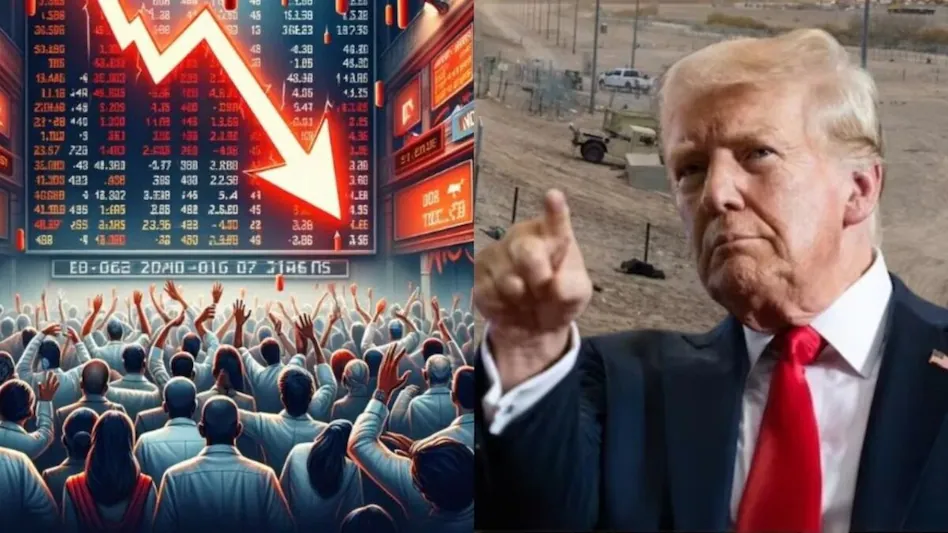
Introduction The global financial markets are facing renewed volatility as the Trump administration announced broader-than-expected reciprocal tariffs. This latest move...
ASML Holding, one of the world’s most crucial semiconductor equipment manufacturers, recently experienced a sharp drop in its stock price, falling by 15% after releasing a gloomy sales forecast earlier than expected. As the global chip industry grapples with uncertainty, the Dutch giant’s revised outlook has raised questions about broader market dynamics, investor confidence, and the impact on the tech sector’s supply chain.
The recent decline in ASML shares is sending shockwaves across the financial and tech landscapes. But what led to this significant drop, and how will it affect the semiconductor sector? Let’s dive deeper into the causes and potential outcomes of ASML’s early earnings release and sales forecast reduction
ASML is not just another tech company. It’s the lifeblood of the global chip manufacturing ecosystem. The company’s extreme ultraviolet (EUV) lithography machines are pivotal for producing cutting-edge semiconductors. These machines are crucial for tech giants like Intel, Samsung, and Taiwan Semiconductor Manufacturing Company (TSMC), which rely on ASML’s advanced equipment to create faster, more efficient chips.
When ASML’s stock drops, it doesn’t just affect the company—it ripples across the entire semiconductor supply chain, potentially stalling technological advancements in AI, mobile devices, and even electric vehicles. The 15% drop is more than just a market correction; it reflects deeper concerns about the future of the semiconductor industry and its growth trajectory
The main reason for ASML’s downward revision in its sales forecast is twofold: weakening demand for consumer electronics and geopolitical challenges that are disrupting the global semiconductor supply chain. As inflation and interest rate hikes impact consumer spending, demand for smartphones, laptops, and other tech gadgets has slowed. This, in turn, has led to a decrease in chip orders from manufacturers.
Furthermore, the ongoing U.S.-China trade tensions have exacerbated the situation. The U.S. government’s restrictions on semiconductor exports to China have led to reduced business opportunities for ASML in one of its largest markets. As China invests in developing its own semiconductor capabilities, ASML’s reliance on Chinese sales has come under scrutiny.
The sales forecast cut is, therefore, a reflection of both shrinking demand and a more challenging geopolitical landscape for the semiconductor industry.
The market reacted swiftly to ASML’s announcement, with shares plunging 15% following the early release of its revised earnings. Investors, who had been optimistic about the company’s long-term growth potential, were caught off guard. Many financial analysts had predicted strong future earnings based on the rising demand for semiconductors, especially with the expansion of AI, 5G, and automotive technology.
However, the sales forecast cut sent shockwaves through the market, prompting a selloff in ASML shares. This reaction underscores how sensitive the market can be to sudden shifts in expectations, especially in an industry as critical and volatile as semiconductors.
ASML’s sales forecast reduction is not just a company-specific issue—it could signify broader troubles for the entire semiconductor industry. The slowdown in chip demand is concerning, especially since semiconductors are the building blocks of modern technology. As consumer spending on electronics declines, semiconductor companies worldwide are likely to feel the pressure.
Furthermore, ASML’s sales cut could trigger a domino effect across the supply chain. Companies that depend on ASML’s machines to produce chips, such as TSMC and Intel, might scale back their production, impacting tech giants like Apple and Samsung, which rely on these chips for their products. This could slow down innovation in the tech sector, delaying the release of new devices and technologies.
Geopolitical factors have played a major role in ASML’s recent sales forecast revision. The U.S. government’s export restrictions on advanced semiconductor technology to China have directly affected ASML’s business. China, being one of the largest markets for semiconductor equipment, is critical for ASML’s growth.
However, the restrictions on selling EUV technology to Chinese companies are hampering ASML’s ability to generate revenue in the region. While ASML continues to supply its older Deep Ultraviolet (DUV) lithography machines to Chinese customers, the absence of EUV sales represents a significant loss in potential revenue. The company is now navigating a complex geopolitical landscape, where balancing business interests and adhering to government regulations is proving to be increasingly difficult.
Despite the recent downturn, many analysts believe that ASML’s long-term prospects remain strong. The demand for cutting-edge chips, particularly in sectors like AI, 5G, and electric vehicles, is expected to rise in the coming years. ASML, being the sole supplier of EUV lithography machines, holds a near-monopoly in advanced semiconductor manufacturing, giving it a unique position in the market.
Moreover, as the global economy recovers and consumer demand for electronics rebounds, ASML’s sales are likely to recover. The company has a strong order backlog, and its technology remains indispensable for the next generation of semiconductors.
However, the road to recovery will not be without challenges. ASML must navigate ongoing geopolitical risks, and the company’s ability to expand into new markets will be critical for its future success.
ASML’s competitors and partners are closely monitoring the situation. For chipmakers like Intel and TSMC, any disruption in ASML’s ability to supply machines could cause delays in their production timelines. These companies depend on ASML’s EUV technology to produce the most advanced chips, and any slowdown in equipment supply could impact their competitiveness.
On the other hand, Chinese semiconductor firms are likely reassessing their dependency on ASML’s technology. With U.S. export restrictions in place, Chinese companies are investing heavily in developing their own semiconductor manufacturing capabilities. While it will take years for China to catch up, the current situation could accelerate the country’s push towards self-reliance in chip production.
For ASML’s investors, the 15% drop in share price is undoubtedly concerning. However, it’s important to take a long-term view. ASML remains a dominant player in a critical industry, and its technology is essential for the future of computing. Short-term fluctuations in the stock price are expected, especially given the current economic uncertainty and geopolitical risks.
Shareholders should consider ASML’s strong fundamentals and its unique market position when evaluating their investment. While the stock may experience volatility in the near term, the company’s long-term growth potential remains intact.
The sharp decline in ASML’s share price has broader implications for the global tech sector. Semiconductors are the foundation of modern technology, and any disruption in the supply chain can have far-reaching consequences. If ASML struggles to meet demand for its machines, it could delay the production of advanced chips, affecting everything from smartphones to data centers.
Tech giants like Apple, Microsoft, and Nvidia are all dependent on cutting-edge semiconductors to power their latest products and services. A slowdown in chip production could impact their ability to innovate and bring new products to market, potentially slowing down technological progress.

Introduction The global financial markets are facing renewed volatility as the Trump administration announced broader-than-expected reciprocal tariffs. This latest move...

Introduction As the world braces for a new wave of tariffs imposed by former U.S. President Donald Trump, global markets...

Market Overview The Indian equity markets faced a turbulent start in Tuesday’s trade, with both the Nifty 50 and Sensex...

Google AI Model Release : The Next Stage in Google’s Virtual Agent Push Google has taken a bold step in...

Ferrari earnings growth 2025 Shares Pop 8% as Luxury Carmaker Sees Further Earnings Growth Ferrari earnings growth 2025 , the...
How China’s DeepSeek Benefits for India: A New Era of Technological Synergy China’s advanced technological solutions, like DeepSeek, have been...