
The United States economy is showing signs of serious deceleration, with early 2025 potentially marking the worst quarterly performance since the COVID-19 pandemic. A combination of abrupt policy decisions, notably from former President Donald Trump, and external economic challenges appears to have shaken both consumer confidence and business activity in the first quarter.
Sluggish Start to 2025
The Commerce Department is set to release its preliminary estimate for the first-quarter gross domestic product (GDP) this Wednesday at 8:30 am ET. This critical data point will offer the most concrete look yet at how the economy is reacting to a new wave of economic nationalism and shifting trade dynamics ushered in by the Trump administration during its return to power.
While official figures are pending, early estimates paint a grim picture. According to financial data firm FactSet, economists are projecting a modest 0.8% annualized GDP growth rate for Q1 2025 — the slowest pace since the second quarter of 2022. Meanwhile, the Federal Reserve Bank of Atlanta’s GDPNow model has projected a much sharper contraction of 2.5%, a figure that would represent the most significant decline since the economic crisis brought on by the COVID-19 pandemic in mid-2020.
Tariff Uncertainty Weighs on Growth
At the heart of the slowdown lies the Trump administration’s aggressive and unpredictable approach to economic policy, particularly regarding international trade. Within just weeks of returning to the White House, President Trump introduced a sweeping set of tariffs aimed at protecting American industries. These measures were met with strong responses from key trading partners and caused considerable anxiety among U.S. importers and exporters alike.
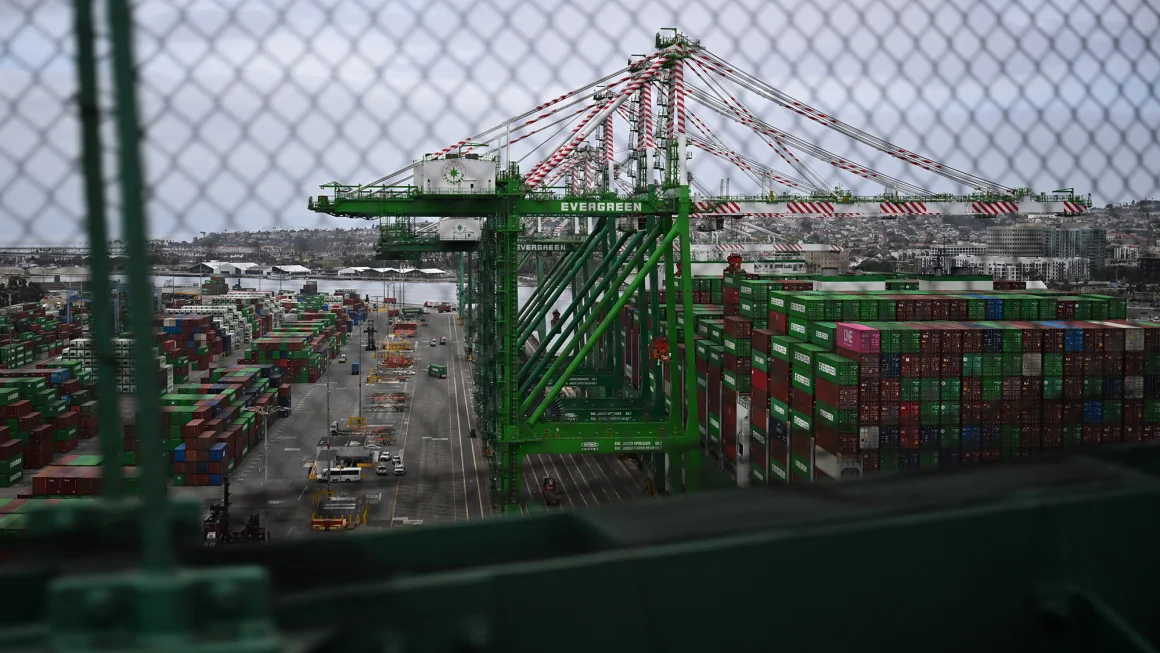
One of the key consequences of this tariff policy has been a surge in imports, as American businesses rushed to stock up on foreign goods before the new duties took effect. While this may have temporarily boosted trade volumes, it had the unintended effect of dragging down GDP. That’s because in the GDP equation, imports are subtracted — meaning higher import volumes can make overall economic growth appear weaker.
Consumers Hold Back Amid Economic Volatility
The uncertainty surrounding the administration’s economic agenda has also led to a noticeable dip in consumer spending. Harsh winter storms across large parts of the U.S. early in the year further exacerbated the slowdown, keeping shoppers indoors and discouraging retail activity. As a result, many companies reported disappointing sales figures in January and February, prompting analysts to lower their growth forecasts for the quarter.
Beyond weather and tariffs, consumers have also shown caution in response to elevated interest rates and inflationary pressures that have persisted into 2025. Although inflation has cooled slightly compared to the peaks of 2022 and 2023, price levels remain high enough to dampen household spending. Uncertainty about future price hikes and employment conditions has led many Americans to save rather than spend.
Business Investment Stalls
Corporate America is also feeling the pinch. Many firms have put expansion and investment plans on hold amid rising economic unpredictability. The administration’s sudden regulatory changes and tariff announcements have made it difficult for businesses to plan ahead or make confident decisions regarding hiring, infrastructure, or research and development.
“There’s a lot of noise in the data from storms, people front-loading and some payback for the strength in the fourth quarter,” explained Nathan Sheets, Global Chief Economist at Citigroup, in an interview with CNN. “But you’ve got this economic concern from how tariffs are going to affect the economy and markets that people are really struggling with.”
Indeed, the strong performance seen in Q4 of 2024 may have been an outlier, driven by pre-election spending and temporary boosts in inventory buildup. As that momentum fades, a more sobering economic reality appears to be taking shape in early 2025.
Fed Policy and the Road Ahead
Another factor weighing on the economy is monetary policy. The Federal Reserve, after several years of aggressive rate hikes to tame inflation, has only recently begun to consider easing its stance. With borrowing costs still relatively high, credit-sensitive sectors like housing, manufacturing, and small businesses remain under pressure.
While some policymakers are hopeful that the Q1 downturn will prove temporary, others worry that the mix of restrictive monetary policy and destabilizing trade actions could push the economy closer to a recession.
Looking forward, much will depend on how quickly the administration clarifies its economic goals. Markets and businesses are craving predictability — without it, volatility and caution may continue to dominate economic activity.
Conclusion: A Critical Inflection Point
The coming months will be critical for the U.S. economy. The sharp divergence in GDP forecasts — from 0.8% growth to a 2.5% contraction — underscores just how uncertain the path ahead remains. With Trump’s return to office bringing sweeping changes in policy, and with global trade dynamics in flux, the U.S. economy is at a crucial inflection point.
Whether the current slowdown is merely a temporary reaction to early policy shifts or a signal of deeper structural challenges will become clearer as more data emerges in Q2. For now, both Wall Street and Main Street are bracing for a potentially turbulent economic ride.