Chinese Lenders and the Challenge of Insufficient Lending | BizBlog News Chinese Lenders Face a Significant Challenge : They Are...
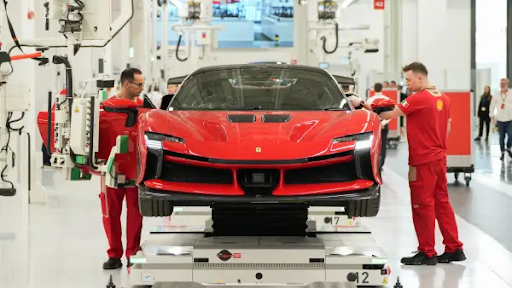
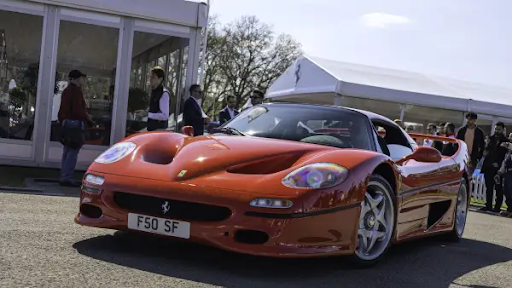
Trump’s recent tariff policies on European imports stunned the world automotive industry in a manner that left Volkswagen, BMW, and Mercedes-Benz shaken. However, of all these, one vehicle manufacturer has managed to walk away scot-free: Ferrari. As its competitors grapple with how to handle a potential crisis, Ferrari, through its unique market position and strategic approach, has remained in a sheltered cocoon .
The Trump administration’s trade policy, which levels the playing field for US manufacturers, has repeatedly put European carmakers in an economic quandary. Economic uncertainty gripped European auto titans as the threat of steep tariffs on imported automobiles loomed large. Auto giants like Volkswagen , BMW , and Daimler saw their stocks plummet and reassessed plans to manufacture as the threat of tariffs as high as 25% loomed in the horizon .
These threats hit Europe’s auto industry particularly hard , as the region relies heavily on the U.S . market . Germany , home to some of the largest car manufacturers in the world, exports a significant percentage of its luxury cars to American consumers . Even a small tariff hike could increase prices for U.S. buyers, weakening demand and slicing into profits .
But amidst all this turmoil, Ferrari seems to glide through the chaos almost untouched. How is this Italian luxury automaker remaining resilient when its peers are scrambling ?
Unlike other European car manufacturers, Ferrari sits in a niche within the automotive space. They cater only to super-rich clients, and their high-end sports cars are as much art forms as they are any ordinary vehicles. Their limited production volumes, exclusivity, and prices that touch the stratosphere make them immune to price-sensitive demands of ordinary consumers .
For Ferrari’s clientele, a 25% tariff on a $400,000 car translates to a price increase that is unlikely to deter a purchase. Wealthy buyers are far less influenced by economic fluctuations than middle-income consumers who might reconsider buying a Volkswagen or BMW if prices rise .
This is not just coincidence; this is deeply embedded in the business strategy of Ferrari. It has managed to attract customers who will pay at whatever premium is charged because it has been focusing on scarcity, exclusivity, and an aspirational brand image .
While for Mercedes-Benz and Audi, it will be quite a complex challenge like shifting production facilities or bargaining over supply chain changes, Ferrari is on a different level . The company’s very limited production volume means that Ferrari doesn’t have the same kind of dependence on the U.S. market as most mass-market automakers do . In 2022 , Ferrari sold around 3,500 cars in the U.S . not exactly a number comparable to Volkswagen Group or BMW selling millions of vehicles.
This minimal exposure makes Ferrari less vulnerable to trade disputes . Secondly , the strategic positioning of the company also allows it to absorb the potential tariff-related costs without affecting its bottom line. Unlike mainstream auto-makers, which have to fight for every dollar and unit in the marketplace, Ferrari commands pricing power that few others can equal .
Ferrari’s ability to sidestep the fallout from Trump ’s tariff threats highlights an important lesson for businesses across industries : having a niche market and a dedicated customer base can provide remarkable protection during economic upheavals . Ferrari ’s strategy underscores the value of focusing on quality , brand loyalty , and customer experience over mass production and scale .
For the European auto giants in a rut , the difference is clear . Ferrari stock has been stable and its sales not impacted . For others , it’s a storm of trade barriers , changing demand, and financial pressure .
Even though the Trump administration is gone, the threat of tariffs continues to hang over the heads of Europe’s automotive sector. The Biden administration kept a few of the trade policies that affect European exports. These trade policies have maintained some degree of uncertainty. For Ferrari , though , the way forward is smooth . The business model and loyal customers cushion its company against these changes .
The broader auto industry for Europe , however , will have to change rapidly for its survival. Diversification into markets, rethinking supply chains around the globe, and innovating around sustainability will have to be the avenues to a future . Then again, the difference that exists between Ferrari and, for example, Volkswagen would mean that adaptability around a changing global economy could determine market positioning .

Chinese Lenders and the Challenge of Insufficient Lending | BizBlog News Chinese Lenders Face a Significant Challenge : They Are...

Nvidia Sees Surge in Retail Investor Interest | AI Powerhouse | Bizblog News Nvidia Experiences a ‘Remarkable’ Surge in Retail...

White Gold: Key to South America Trade Agreement | BizBlog News White Gold: The Cornerstone of Europe’s Trade Agreement with...

Google AI Model Release : The Next Stage in Google’s Virtual Agent Push Google has taken a bold step in...
Ferrari earnings growth 2025 Shares Pop 8% as Luxury Carmaker Sees Further Earnings Growth Ferrari earnings growth 2025 , the...
How China’s DeepSeek Benefits for India: A New Era of Technological Synergy China’s advanced technological solutions, like DeepSeek, have been...